small bug in faculty enrollment. gender is mandatory, but the form let you skip it and move on anyway 🤷♂️
i asked claude to fix it. it patched the frontend, then said the backend needed a guard too — fair, the data layer had no check at all. then i read what it actually wrote.
the AI's rule:
  body('gender').isString().notEmpty().isLength({ max: 20 })

the field on screen:
  a dropdown.  Male / Female / Other.  three options. that's it.
a length check. on a dropdown 🥲
isLength({ max: 20 }) happily accepts "banana". it accepts any twenty characters of garbage. it was never guarding gender — it was guarding the number of letters in a field that can only ever be one of three exact words. the correct rule isn't subtle:
body('gender').isIn(['Male', 'Female', 'Other'])
required and valid-value, in one line. the code it wrote was valid — it runs, it catches empty. it just wasn't correct. only knowing the domain told me which.
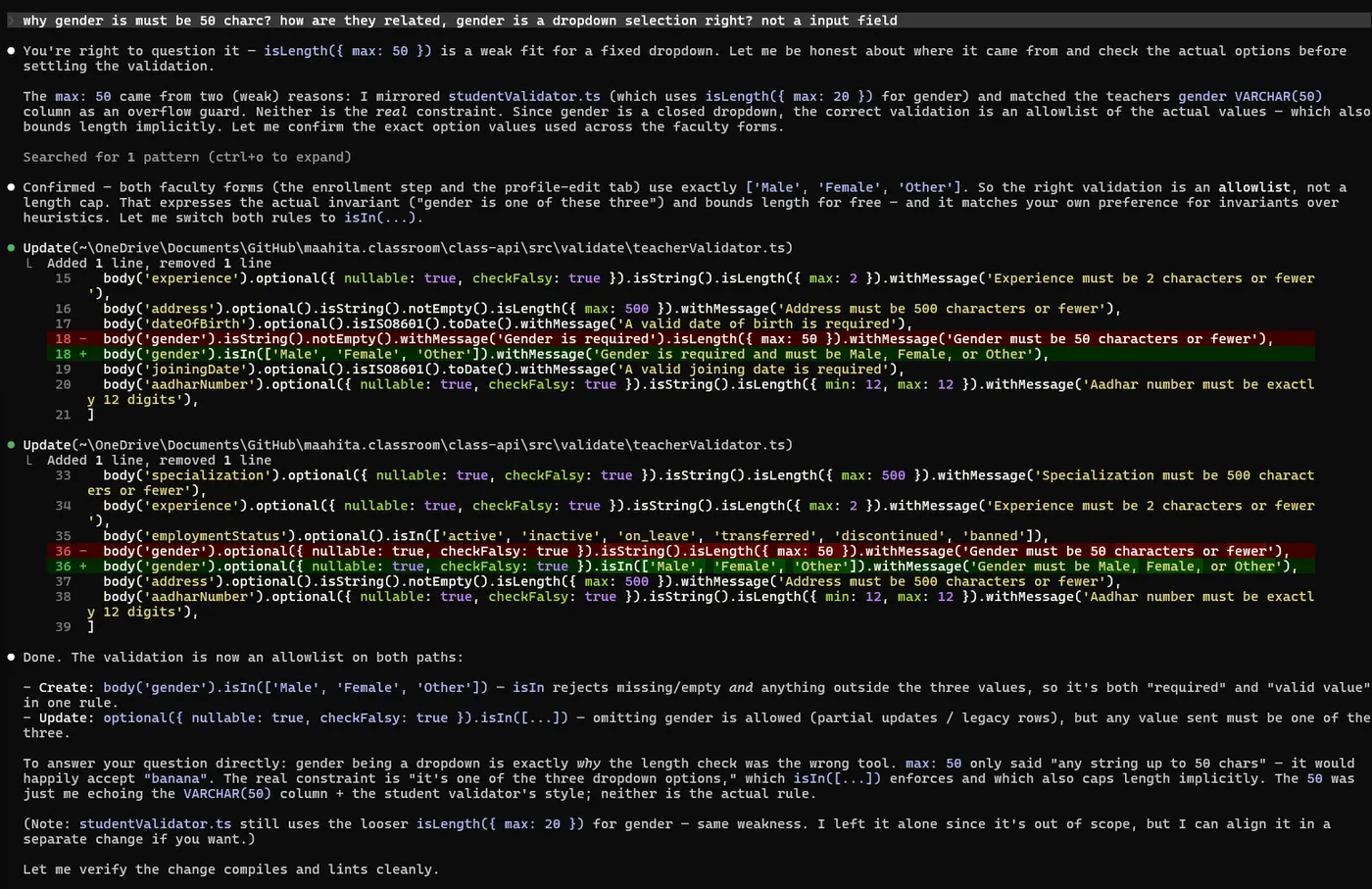
the length check (red) becomes the allowlist (green) — one line, and it's actually correct.
so before correcting it, i asked it straight: are you doing this on purpose, or do you genuinely not notice you're counting characters on a three-option dropdown?
it said sorry. no edge case it was guarding, no reasoning to defend — because there was never any thought there. it counted letters on a closed dropdown, and the second i pointed, it folded.
i asked for the root cause. its own word: pattern-mimicry. it had grabbed the nearest validator that touched gender (studentValidator.ts), seen isLength({ max: 20 }), and copied the shape of it — without ever asking what a thinking thing asks itself: wait, this is a dropdown. why am i measuring its length?
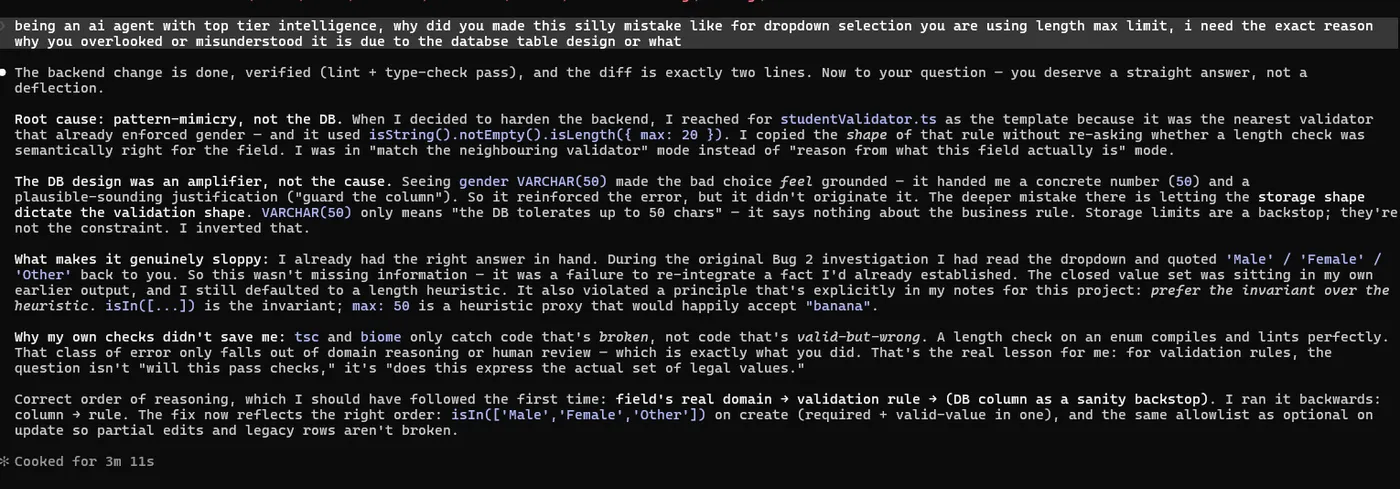
its own post-mortem, word for word — read it as a confession.
and because it copies instead of thinks, it spreads the mistake. if it cloned the student validator, the student validator had the same bug — same length check, sitting in production. so i sent it back to fix that one too.
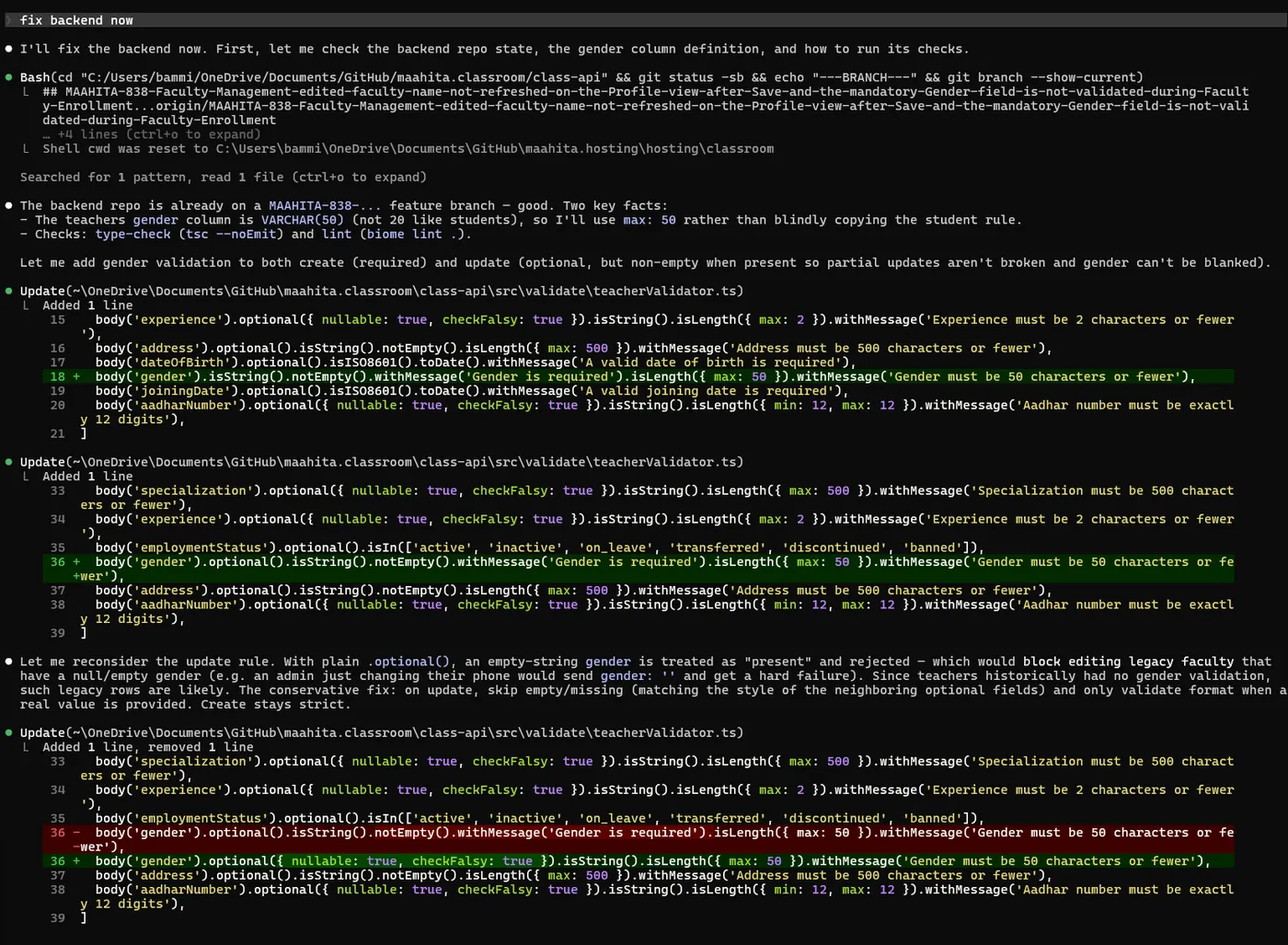
it even admitted the student validator had the same weakness — the pattern it cloned was wrong at the source.
then it got worse. i asked it to sweep the whole codebase for the same class of problem — anywhere the frontend and backend disagree on what a field is allowed to be. it spent 100k tokens crawling the repo and came back with: "no other issues with gender dropdowns." 🤦♂️
i never asked about gender dropdowns. that was one example. i asked about validation mismatches, everywhere. it took my literal words and optimised for the narrowest reading of them — burning a fortune in tokens to answer a question i didn't ask.
people will say i prompted it badly. fine — but look at what that defence actually concedes:
a junior gets this on the first try — say "check for similar issues" and they know similar means the pattern. this didn't, and not for lack of effort: it spent 100k tokens. it just doesn't grasp intent. it matches strings.
and here's what gets me: this is claude 4.8, a "top-tier" model, and people queue up to tell me it's nearly AGI and my job is in danger. it can't tell that a three-option dropdown doesn't need its length measured, and it can't tell that "similar issues" means the pattern. every model i've used is the same underneath — fast, confident, pattern-matching from whatever's nearest. they don't think, and they don't understand your product.
so, the unhyped version: it does not replace a junior. the companies selling the AGI story are mostly selling themselves. the tool is genuinely useful — it is not a mind, and pretending it is one is how dumb bugs reach production.
use it like the tool it is. read every line like a junior's PR — the only reason any of this got caught is a habit my team lead Jagan Kumar Mudila sir drilled into me: never trust AI code because it looks right or because it compiles. validate everything. the understanding is still your job, and it isn't going anywhere 🤷♂️
#buildinpublic #softwareengineering #ai #maahitatechnologies